

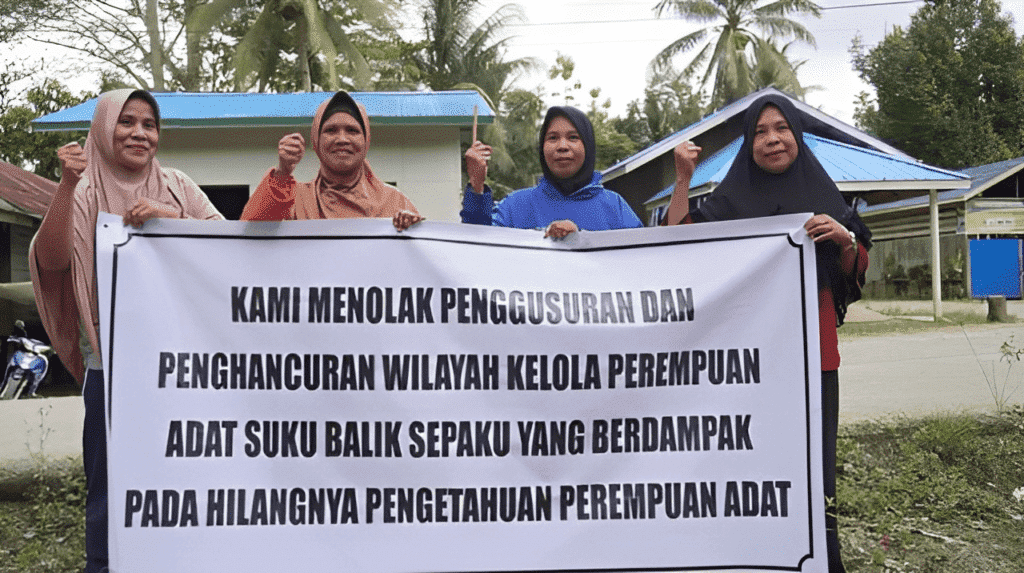
Indigenous women of the Balik tribe resist the eviction of land and women’s management areas in Sepaku Lama, Penajam Paser Utara, East Kalimantan Photo credit: JATAM East Kalimantan
ELEVATE (Enhancing the Leverage of Women Environment Human Rights Defenders/WEHRDs in Sustaining the Environment) is a KEMITRAAN project aimed at increasing the capacity and influence of women human rights defenders (WHRDs/PPHAM) in preserving the environment.
According to Komnas Perempuan, there were 87 cases of violence and attacks on women human rights defenders that were directly reported in the period 2015-2021. However, this number is considered an iceberg phenomenon, as there are many unreported cases.
Capacity building and influence are focused on women and communities whose land and natural resource rights are threatened by large-scale development projects, such as the expansion of monoculture plantations or extractive industries that do not take into account environmental aspects.
About the project
Background
Public participation is crucial in influencing the formulation and implementation of state regulations, policies, and decisions. However, there is a tendency for the state to limit participation in the policy-making process, one of which is experienced by human rights defenders in the form of threats, violence, and criminalization. The risks faced by women environmental human rights defenders (WEHRDs) are multiplied, not only targeting them as individuals but also their identities as women, mothers, and community members. Sexual assault, stigmatization, discrimination and neglect are often experienced.
Objective
The two main objectives of the ELEVATE project are:
a. To encourage the existence of state protection mechanisms and community-based protection for women environmental human rights defenders (WEHRDs).
b. Increase the leadership capacity and influence of environmental PPHAM and Civil Society Organizations (CSOs) to advocate for gender-sensitive policies in the environmental sector.
Project duration
October 2022 – January 2025
Work area
National level and provincial level (Riau, East Kalimantan, Central Sulawesi)
Work Program (Program Kerja)
In implementing the ELEVATE project, besides direct implementation, KEMITRAAN also works together with partners at both the national and local levels, including in the provinces of Riau, East Kalimantan, and Central Sulawesi.
The strategies to achieve the program’s objectives are:
a. Capacity building for Women Environmental Human Rights Defenders (WEHRDs), communities, and supporting civil society organizations regarding the safety and protection of WEHRDs, as well as network strengthening.
b. Technical support to encourage collective efforts between the state and civil society organizations in providing legal protection instruments that are gender-sensitive for women environmental human rights defenders.
c. Research on the protection conditions of women human rights defenders in Indonesia and the conditions of women in mining and palm oil locations.
d. Advocacy to influence protection policies for Women Environmental Human Rights Defenders (WEHRDs) so that they can actively participate in negotiating gender-sensitive policies in natural resource and environmental management. These activities include advocating for priority issues related to gender-sensitive environmental HRDs, conducting multi-stakeholder dialogues to support capacity building and protection for HRDs, case advocacy in assisted communities, and providing emergency assistance for HRD cases.
e. Knowledge and learning management as a crucial process to integrate data and information from various initiatives carried out by civil society actors through the improvement of the HRDKS (Human Rights Defenders Knowledge System). The system is a platform for sharing, exchanging information and knowledge products on human rights defenders’ issues and PPHAM.
The ELEVATE project is expected to deliver the following results:
Research, including:
a) Risks faced by Human Rights Defenders (HRDs) and Women Environmental Human Rights Defenders (WEHRDs) and the legal framework gap concerning the protection of WEHRDs in the environment sector (LH).
b) Annual Report: The current situation faced by WEHRDs in the environment sector (LH), including types of attacks and the state’s response to these attacks; existing changes in law and other policies related to HRDs and WEHRDs in the environment sector (LH).
c) Documentation of good practices and lessons learned related to the strategies and challenges faced by WEHRDs in the environment sector (LH) at the national and regional levels.
d) The impact of the Job Creation Law (UU Cipta Kerja) on the conditions of women in the palm oil and mining sectors, as well as conducting advocacy to refine the Law and its implementing regulations.
2) In partnership with civil society organizations at the national level, conducting policy advocacy related to: a) Protection of WEHRDs in the environment sector (LH) against the Threat of Criminal Defamation under the new Criminal Code (KUHP) b) Revision of the Information and Electronic Transactions (ITE) Law c) Strengthening the Implementation of ANTI-SLAPP Provisions under Article 66 of the Law on Environmental Protection and Management
3) Training on gender-sensitive community-based protection mechanisms for Human Rights Defenders in environmental issues, in partnership with civil society organizations in Riau, East Kalimantan, and Central Sulawesi Provinces.
4) Capacity building for civil society organizations through:
a) Training on protection and security mechanisms for 6 local partners in Riau, East Kalimantan, and Central Sulawesi Provinces and 3 national partners.
b) Advocacy for gender-sensitive environmental policies for WEHRDs in the environment sector (LH) and CSOs.
5) National report on WEHRD case data and handling.
6) The establishment of HRDKS (Human Rights Defenders Knowledge System) as a system for documenting attacks and handling WEHRD cases in the environment sector (LH).
7) Emergency assistance for Human Rights Defenders facing threats, attacks, and criminalization.
8) National coalition for WEHRD advocacy in the environment sector (LH) and promoting an action plan to strengthen gender-sensitive policy advocacy in the palm oil and mining sectors.