

By: Yael Stefani – Estungkara
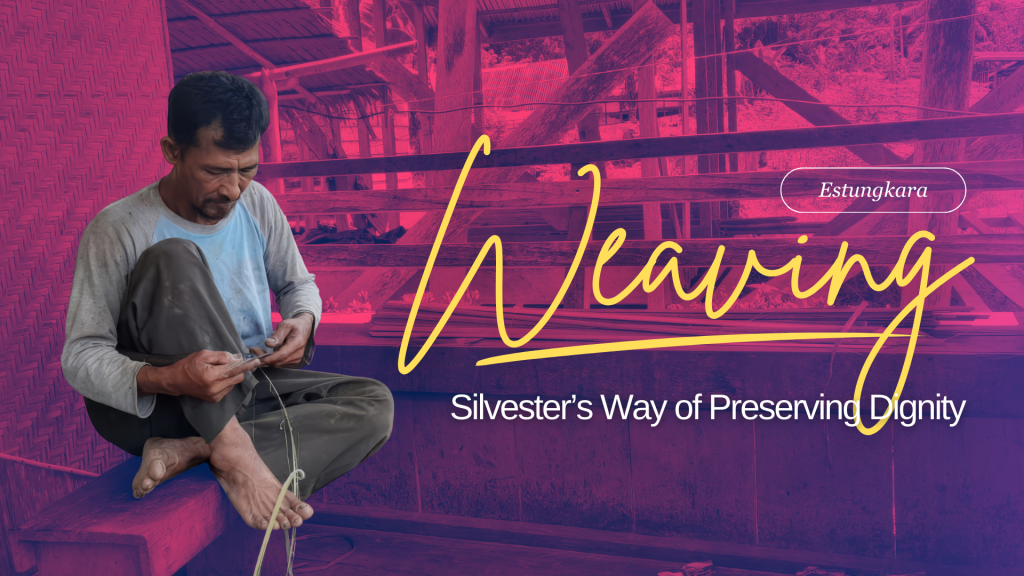
Silvester S. (49) sits on the veranda of his home in Mentawai. Occasionally, his eyes glance at the dogfruit crackers drying in the yard, while his hands continue shaving strips of sago bark he has just collected from his field, about one kilometer from his house. His movements are calm and repetitive, forming thin slats that will become the material for weaving.
The smoothed sago bark is arranged in crisscrossing layers, forming weaving patterns he only mastered recently. Weaving is not unfamiliar to Silvester. Since childhood, he was accustomed to watching his parents weave various household tools. However, like most Mentawai men, much of his life has been spent farming and fishing at sea.
Silvester’s interest in weaving grew only in recent years, when a field facilitator working in his village encouraged him to try weaving on his own. At first, he hesitated. He felt he lacked the skills, possessing only faint memories of how his parents once worked with rattan and tree bark. Yet the urge to try and the belief that this knowledge had long resided within him, gave him the courage to experiment. His first woven piece relied on memory, childhood observation, and readings he had accessed when he was active in children’s education activities.
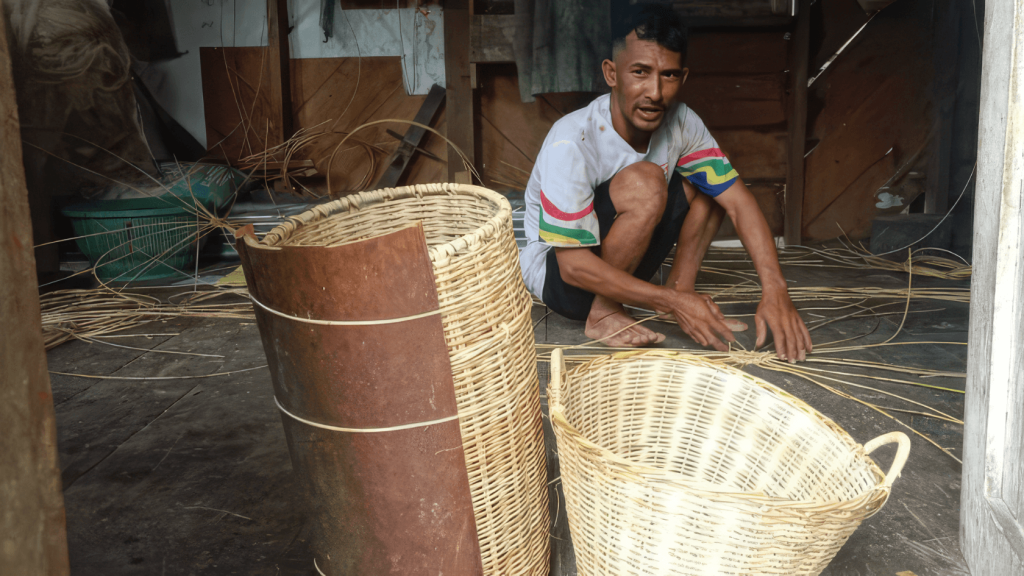
In Mentawai, weaving is not merely a technical skill. It is part of lived practice and cultural identity. Both men and women are expected to be able to weave. The more skilled a person is, the greater the respect they receive within the family. A man needs a bow and arrows to hunt wild boar, deer, or monkeys, while women require woven fishing traps for the river. In addition, household items, from field baskets to ritual wedding equipment (pakandei) are all products of weaving.
For this reason, weaving skills for a head of household are akin to dignity. A man may be ridiculed and considered “not Mentawai” if he cannot weave. This awareness is what drives Silvester to diligently learn the craft. By making his own tools, he is not only producing goods but also safeguarding his self-respect as a Mentawai man.
In recent years, weaving has become part of Silvester’s family economic strategy. This change did not happen overnight, but grew through a process of learning, social interaction, and participation in mentoring and training programs. Beyond weaving techniques, the training also opened Silvester’s eyes to the importance of sharing roles within the family, using weaving as an analogy. When domestic responsibilities are entirely handled by his wife, only Silvester has time to weave.
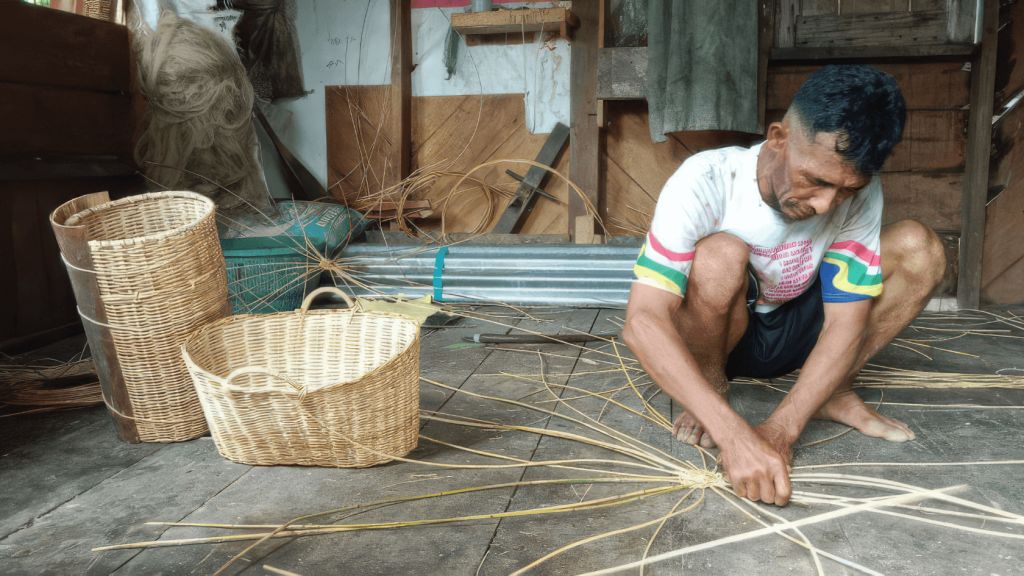
From this realization, he began to establish a more deliberate division of roles between them. Time management created space for weaving, often done at night or between other activities.
Similarly, domestic responsibilities become his wife’s duty when Silvester goes out to sea. When at home, Silvester takes turns handling household tasks while weaving. As a result, this pattern creates balance, enabling productive activities to continue without neglecting childcare.
Since taking up weaving, Silvester’s home has become not only a space for consumption but also a place of production and economic decision-making. This practice reflects a form of micro-level governance that often goes unnoticed, yet directly influences the sustainability of the family’s livelihood.
Income from weaving provides Silvester with additional earnings, starting from IDR 300,000 per month, and reaching as much as IDR 1.2 million when orders increase and materials are available. This income complements farm produce,such as bananas, areca nuts, coconuts, dogfruit, and cloves that primarily sustain the family’s daily needs.
Meanwhile, fishing activities are maintained, although the catch is mainly used for household consumption, saving approximately IDR 20,000–25,000 per kilogram in daily fish expenses. This livelihood diversification serves as an adaptive strategy in the face of economic uncertainty, without abandoning long-standing ways of life.
The additional income from weaving provides flexibility for Silvester’s family economy: buying sugar, paying electricity bills, meeting children’s needs, and purchasing wood, tools, and materials to build a kitchen.
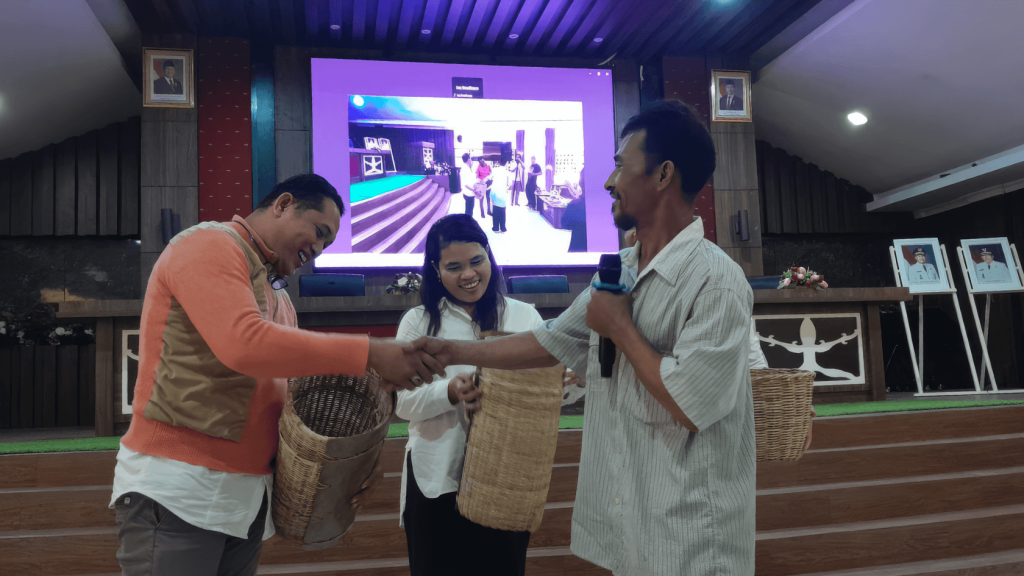
In November 2025, he had the opportunity to participate in a dialogue between marginalized groups and the Mentawai Regency government, while also joining an exhibition organized by the Regional National Crafts Council (Dekranasda). The event allowed Silvester to market his woven products and gain access to distribution facilities to regional craft centers with more affordable logistics mechanisms.
This experience broadened Silvester’s long-term outlook. Weaving is no longer seen as a supplementary activity, but as part of a strategy for economic sustainability and the preservation of cultural knowledge. He plans to build a small production hut behind his house to serve as a workspace, storage area, and learning space for anyone interested in studying weaving, regardless of age or gender.
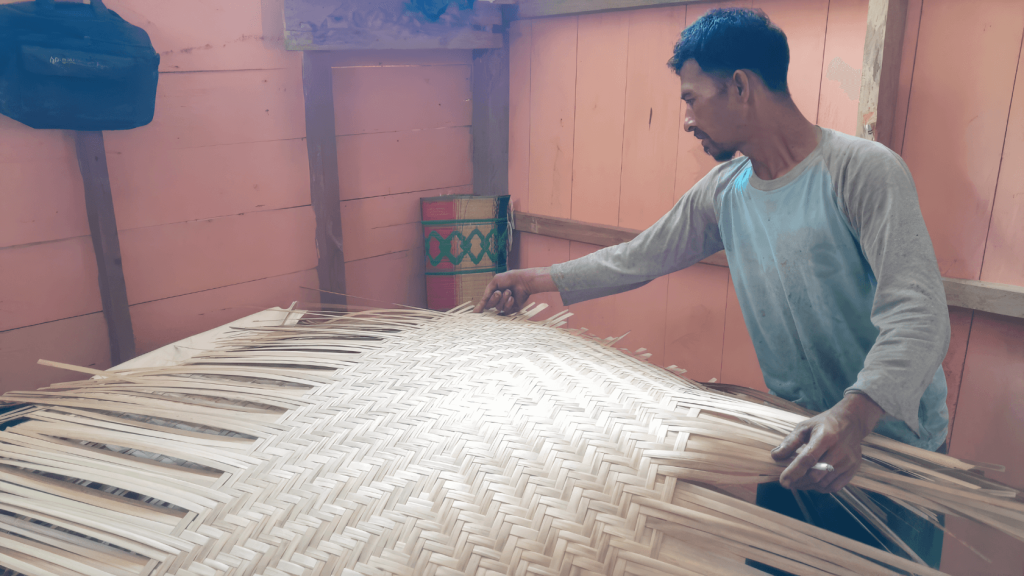
Silvester now realizes that the weaving he has pursued over the past few years is not merely about functional objects, but also about preserving cultural identity and enabling him and his community to continue adapting and finding relevance amid the pace of social and economic change.