Home / Story

Pekalongan’s Ecological Batik: An Economic Opportunity Amid Climate Change Adaptation Efforts

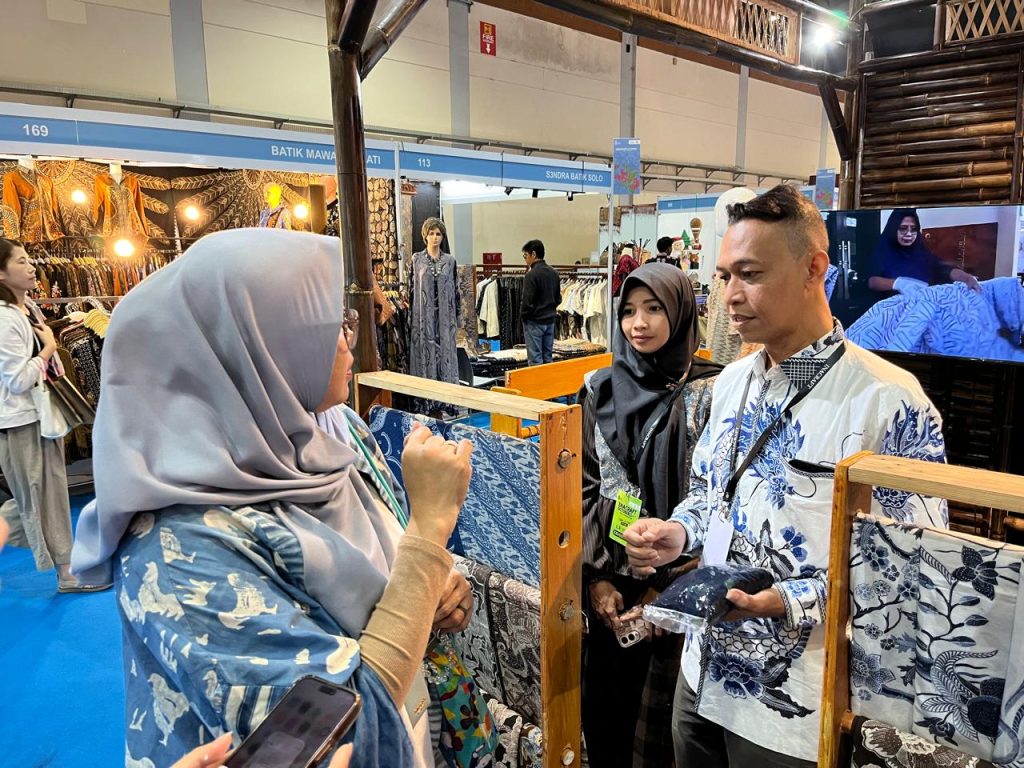
JAKARTA – Pekalongan Ecological Batik, supported by KEMITRAAN, is once again making an appearance at a major exhibition. This time, Ecological Batik is participating in Inacraft 2025 at the Jakarta Convention Center in Senayan, Central Jakarta, from October 1–5, with support from the Adaptation Fund and the Pekalongan City Government.

Ecological Batik is one of the projects in the climate change adaptation program in Pekalongan City, initiated by KEMITRAAN with funding support from the Adaptation Fund. The presence of Ecological Batik at Inacraft serves as a step to disseminate information to the public about climate change adaptation efforts, which also generate economic opportunities.

Initially, this project was a PARTNERSHIP effort to prevent groundwater pollution in Pekalongan City amidst the climate crisis exacerbated by synthetic batik waste. However, Ecological Batik, which uses natural dyes, has opened up new economic potential.

Didit Handika, Project Officer for KEMITRAAN in Pekalongan, stated that Ecological Batik, which uses natural dyes, does not pollute the environment or groundwater because the dyes are derived from plants. Some of the plants used as natural batik dyes include indigo, ketapang, and secang. The production process is also very water-efficient.

“Ecological batik differs from synthetic dyes, which require a lot of water. Ecological batik uses only a quarter of the water used in synthetic dye batik production. This reduces water pollution,” said Didit.

He added that initially, only a few batik makers from Pekalongan City joined the Ecological Batik group because the production process was longer and more complicated. However, over time, the batik makers who joined began to see results. They were able to sell their batik products at higher prices due to the more complex production process.

Didit also stated that batik makers nowadays aren’t just selling the motifs, but also the stories behind the production process. Given the compelling story of Ecological Batik, which uses plants as dyes, consumers are willing to pay more than those using synthetic dyes.

“Batik products, especially for international consumers, must be environmentally friendly and sustainable. They should be interested not only in the motifs but also in the manufacturing process,” said Didit.

This was confirmed by Andaru, one of the batik makers assisted by KEMITRAAN who exhibited his products at Inacraft. He said his products are mostly purchased by batik enthusiasts from abroad.

“Most of the buyers are from Japan. They buy batik,” Andaru said.

Didit added that since its inception, KEMITRAAN has been targeting Micro, Small, and Medium Enterprises (MSMEs) as partners in the Ecological Batik group. Based on KEMITRAAN’s mapping in Pekalongan, groundwater and clean water pollution generally occurs in residential areas. It is in these areas that most MSMEs produce batik.

Didit also stated that enthusiasm among batik makers in Pekalongan City is now growing, especially among large-scale batik makers. They see the growing potential for sales from natural dye batik.

“They were very interested because our approach ensures a full end-to-end process. We support everyone from production, institutions, raw materials, and marketing. They feel the commitment we’re building isn’t just a business commitment, but a sustainable, mutually supportive one,” said Didit.

“We hope that in the future, more batik makers will join Batik Ecologis so that the future of natural dye batik will be brighter,” he continued.

2020

This agreement was signed between Green Climate Fund (GCF) and PARTNERSHIP. This agreement formalizes KEMITRAAN’s accountability in implementing projects approved by the GCF.

For your information, the GCF is the world’s largest special fund that helps developing countries reduce greenhouse gas emissions and increase their ability to respond to climate change.

These funds were collected by the United Nations Framework Convention on Climate Change (UNFCCC) in 2010. The GCF has an important role in realizing the Paris Agreement, namely supporting the goal of keeping the average global temperature increase below 2 degrees Celsius.

2000-2003

KEMITRAAN played a crucial role in supporting the development of legislation to establish the KPK. This was followed by steps to support the Government and DPR in selecting competent commissioner candidates and also supporting civil society groups to critically monitor the selection process. After the commissioners were appointed, they asked KEMITRAAN to help with the institutional design and initial recruitment of the KPK, as well as play the role of donor coordinator. It is clear that KEMITRAAN plays a key role in supporting the Corruption Eradication Commission to develop the capacity and strategies needed to work as effectively as possible.

2016

In March 2016, KEMITRAAN received international accreditation from the Adaptation Fund. The Adaptation Fund Board, in its 27th meeting, decided to accredit KEMITRAAN as National Implementing Entity (NIE) from the Adaptation Fund. KEMITRAAN is the first and only Indonesian institution to be accredited as a NIE Adaptation Fund in Indonesia.

2003

In 2003, KEMITRAAN became an independent legal entity registered as a Non-Profit Civil Partnership. At that time, KEMITRAAN was still a program managed by UNDP until the end of 2009. Since the beginning of 2010, KEMITRAAN took over full responsibility and accountability for the programs and their development.

1999-2000

The Partnership for Governance Reform, or KEMITRAAN, was founded in 2000 following Indonesia’s first free and fair general election in 1999. This historic election is an important step in Indonesia’s efforts to move away from an authoritarian past towards a democratic future. PARTNERSHIP was established from a multi-donor trust fund and is managed by United Nations Development Programme (UNDP) with a mandate to advance governance reform in Indonesia

1999-2000

Kemitraan bagi Pembaruan Tata Kelola Pemerintahan, atau KEMITRAAN, didirikan pada tahun 2000 setelah berlangsungnya pemilihan umum pertama di Indonesia yang bebas dan adil pada tahun 1999. Pemilu bersejarah ini merupakan langkah penting dalam upaya Indonesia keluar dari masa lalu yang otoriter menuju masa depan yang demokratis. KEMITRAAN didirikan dari dana perwalian multi-donor dan dikelola oleh United Nations Development Programme (UNDP) dengan mandat untuk memajukan reformasi tata kelola pemerintahan di Indonesia.

2020

This agreement was signed between Green Climate Fund (GCF) and PARTNERSHIP. This agreement formalizes KEMITRAAN’s accountability in implementing projects approved by the GCF.

For your information, the GCF is the world’s largest special fund that helps developing countries reduce greenhouse gas emissions and increase their ability to respond to climate change.

These funds were collected by the United Nations Framework Convention on Climate Change (UNFCCC) in 2010. The GCF has an important role in realizing the Paris Agreement, namely supporting the goal of keeping the average global temperature increase below 2 degrees Celsius.

2020

This agreement was signed between Green Climate Fund (GCF) and PARTNERSHIP. This agreement formalizes KEMITRAAN’s accountability in implementing projects approved by the GCF.

For your information, the GCF is the world’s largest special fund that helps developing countries reduce greenhouse gas emissions and increase their ability to respond to climate change.

These funds were collected by the United Nations Framework Convention on Climate Change (UNFCCC) in 2010. The GCF has an important role in realizing the Paris Agreement, namely supporting the goal of keeping the average global temperature increase below 2 degrees Celsius.

2016

In March 2016, KEMITRAAN received international accreditation from the Adaptation Fund. The Adaptation Fund Board, in its 27th meeting, decided to accredit KEMITRAAN as National Implementing Entity (NIE) from the Adaptation Fund. KEMITRAAN is the first and only Indonesian institution to be accredited as a NIE Adaptation Fund in Indonesia.

2003

In 2003, KEMITRAAN became an independent legal entity registered as a Non-Profit Civil Partnership. At that time, KEMITRAAN was still a program managed by UNDP until the end of 2009. Since the beginning of 2010, KEMITRAAN took over full responsibility and accountability for the programs and their development.

2000-2003

KEMITRAAN played a crucial role in supporting the development of legislation to establish the KPK. This was followed by steps to support the Government and DPR in selecting competent commissioner candidates and also supporting civil society groups to critically monitor the selection process. After the commissioners were appointed, they asked KEMITRAAN to help with the institutional design and initial recruitment of the KPK, as well as play the role of donor coordinator. It is clear that KEMITRAAN plays a key role in supporting the Corruption Eradication Commission to develop the capacity and strategies needed to work as effectively as possible.

1999-2000

The Partnership for Governance Reform, or KEMITRAAN, was founded in 2000 following Indonesia’s first free and fair general election in 1999. This historic election is an important step in Indonesia’s efforts to move away from an authoritarian past towards a democratic future. PARTNERSHIP was established from a multi-donor trust fund and is managed by United Nations Development Programme (UNDP) with a mandate to advance governance reform in Indonesia